How to Read a Peptide Certificate of Analysis (COA)
What purity, identity and batch numbers on a peptide COA actually mean, and the red flags to look for before you order.
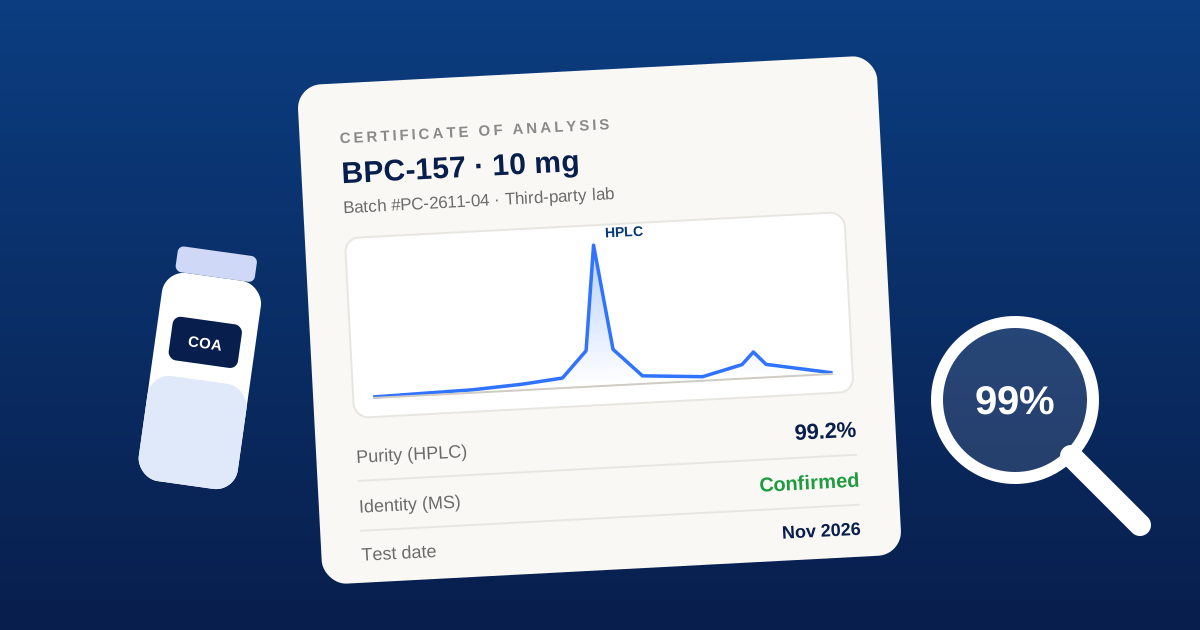
A certificate of analysis (COA) is a lab report for a specific batch of a product. For research peptides, it is the main evidence that what is in the vial matches the label.
The parts of a COA
- Product name and amount | for example BPC-157, 10 mg. It should match the vial you buy.
- Batch or lot number | the COA must refer to the same batch printed on your product. A COA for a different batch tells you little.
- Testing laboratory | the name of the lab that ran the test. Independent third-party labs carry more weight than in-house testing.
- Test date | recent tests are more relevant than reports that are years old.
- Purity (HPLC) | high-performance liquid chromatography reports the percentage of the sample that is the target compound. Research suppliers often report 98-99%+.
- Identity (mass spectrometry) | MS confirms the molecular mass matches the expected peptide.
- Quantity | some labs also measure the actual amount of peptide in the vial versus the labelled amount.
Red flags
- No batch number, or a batch number that doesn't match your product.
- A report that can't be verified with the testing lab.
- Purity reported without a chromatogram.
- The same COA reused across many products or years.
Use COAs alongside coupon codes
A large discount is only worth it if the product is what it claims to be. Our vendor pages show how many COAs a supplier publishes where we have that data.
Frequently asked questions
What purity should a research peptide COA show?
Many research suppliers report HPLC purity of 98% or higher. Always check that the COA matches your batch.
What is HPLC on a COA?
High-performance liquid chromatography, a test that separates the sample to estimate what percentage is the target compound.